
Smart Healthcare, Not Bigger Hospitals: Solving the Global Health Crisis with AI and Remote Care

Updated: Jun 26, 2025

Introduction
The global health crisis is no longer just about treating diseases but about transforming the way we approach health altogether. For decades, the response to rising healthcare demands has been to build bigger hospitals and expand medical infrastructure. However, this approach is no longer sufficient.
"The best way to predict the future is to invent it." — Alan Kay, Computer Scientist and Pioneer in Personal Computing This quote perfectly encapsulates how healthcare innovators are shaping the future with artificial intelligence (AI), remote care, and a focus on patient-centered systems.
In today’s world, the conversation must shift toward smarter healthcare—harnessing technology, data, and human-centered design to provide accessible, affordable, and high-quality care. It's no longer about increasing the number of hospital beds but about delivering care where people need it most, in a manner that’s proactive and efficient.
1. The Healthcare Crisis at a Glance
The traditional healthcare model, rooted in brick-and-mortar facilities and in-person treatment, is being tested by modern pressures:
Shortage of healthcare professionals: WHO predicts a shortfall of 10 million healthcare workers by 2030.
Inaccessibility in rural areas: 80% of healthcare infrastructure is concentrated in urban centers, leaving rural populations underserved.
Rising costs: Traditional hospital-centric models are expensive, both for providers and patients.
Overcrowded hospitals: Overburdened healthcare systems can’t provide timely treatment to everyone.
"The healthcare industry is going to be a key issue for the next few decades, and it’s going to be deeply affected by technology." — Bill Gates, Co-Founder of Microsoft and Philanthropist Gates has long recognized the profound role technology will play in transforming healthcare, from diagnostics to treatment delivery.
The COVID-19 pandemic highlighted the fragility of hospital-centric care models, revealing the need for smarter, more accessible healthcare options.
2. Smart Healthcare: What Does It Mean?
Smart healthcare refers to a system where technology and data empower care providers to deliver more personalized, effective, and timely healthcare. It’s about shifting from a reactive approach to a proactive, predictive one.
Key elements include:
AI-based diagnostics
Wearables and IoT (Internet of Things)
Telemedicine and virtual care
Remote therapeutic monitoring (RTM)
Electronic Health Records (EHR) and Health AI Analytics
These technologies are reshaping the way healthcare is delivered, making it more personalized and efficient while ensuring broader reach.
3. Why Bigger Hospitals Aren’t the Solution Anymore
While expanding healthcare infrastructure is important, simply building bigger hospitals isn’t a sustainable solution for the global health crisis. Here’s why:
a. Cost vs. Reach
Building and maintaining hospitals are expensive, and these resources are limited. AI and remote care can be deployed at a fraction of the cost and can reach patients across the globe, from urban to rural areas.
b. Urban Bias
80% of hospitals are in urban areas, while the majority of the population in many developing countries live in rural or tier-2 towns.
c. One-to-Many Scalability
A single doctor can only attend to a handful of patients at a time, while AI-assisted platforms can increase this reach exponentially.
"AI is probably the most important thing humanity has ever worked on. I think it’s more profound than electricity or fire." — Sundar Pichai, CEO of Alphabet Inc. (Google) Pichai emphasizes the transformational power of AI, and in healthcare, AI is not just a tool—it’s a game-changer that will allow us to rethink how healthcare is distributed and delivered.
4. AI’s Transformative Role in Healthcare
Artificial intelligence is already making waves in healthcare with innovations that were once thought impossible:
AI in Radiology: AI algorithms like DeepMind’s AI system can analyze X-rays and detect abnormalities like cancers, sometimes even more accurately than humans.
Triage Bots: AI-powered chatbots can assess symptoms, provide preliminary diagnoses, and recommend treatment, significantly reducing wait times.
Personalized Treatment: AI systems use genetic data and patient histories to create personalized treatment plans, improving outcomes and reducing trial and error in treatments.
Predictive Models: AI can predict the onset of diseases such as cancer and diabetes before symptoms appear, giving patients a chance at early intervention.
These technologies allow healthcare providers to monitor patients remotely, even in rural or underserved areas, ensuring that treatment and care are delivered faster and more accurately.
5. Remote Care: Scaling Human Touch through Technology
Remote care is not about replacing healthcare professionals but empowering them with the tools they need to care for more people, more efficiently.
a. Telemedicine
Telemedicine enables virtual consultations between patients and healthcare providers, allowing specialists to consult with patients across vast distances.
b. Remote Monitoring
Wearable devices track a patient’s vital signs in real-time, sending data to healthcare providers who can monitor the patient’s condition remotely and intervene if necessary.
c. Home Diagnostics
Diagnostic kits allow patients to perform tests at home, such as blood tests, and send the results to cloud platforms where AI can analyze them, reducing the need for hospital visits.
"Innovation is the ability to see change as an opportunity – not a threat." — Steve Jobs, Co-Founder of Apple Jobs' quote is particularly relevant as healthcare transforms in the face of AI. The technology is not here to replace care but to enhance it and make it more efficient.
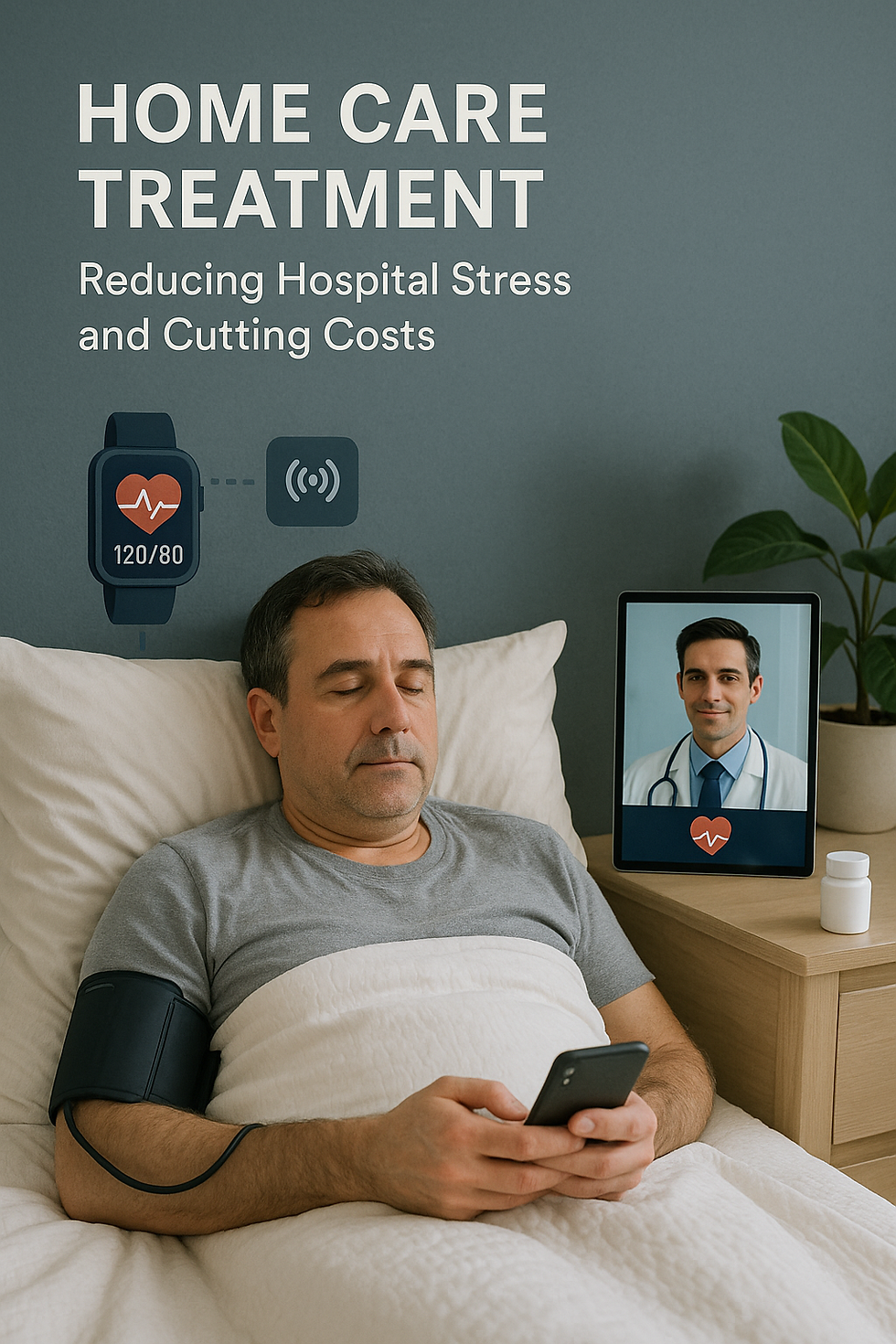
6. Home Care Treatment: Reducing Hospital Stress and Cutting Costs
Home care is a key component in the shift toward smarter, more accessible healthcare. In a world where AI and remote monitoring are becoming increasingly available, more people can receive the care they need without stepping foot in a hospital.
Why Home Care Makes Sense Today
Hospitalization is often unnecessary for many patients who simply need monitoring or low-level interventions. With AI-powered devices and platforms, patients can receive treatment and care in the comfort of their homes, reducing both the strain on hospitals and the stress on patients.
Key Components of AI-Driven Home Care
1. Remote Monitoring Devices
Devices that monitor vitals such as blood pressure, blood glucose levels, ECG, and oxygen levels can continuously track a patient's health status.
2. AI-Powered Decision Support
AI systems can analyze the data from remote monitoring devices and alert healthcare providers to any concerning trends or changes, helping guide treatment.
3. On-Demand Medical Assistance
Platforms like Portea or Medically Home allow patients to receive care at home from nurses, physiotherapists, and even doctors, reducing hospital overcrowding and providing patients with timely treatment in familiar surroundings.
4. Cloud-Based Diagnostics and Consultation
AI-enabled diagnostic kits and cloud platforms allow patients to perform tests at home, providing doctors with real-time results for accurate assessments.
Impact on Healthcare Systems
a. Reduced Overcrowding
Home care significantly reduces the need for hospital admissions, freeing up beds for patients who require acute care.
b. Cost Efficiency
By bypassing hospital stays and room charges, home care reduces healthcare costs by up to 50%.
c. Faster Recovery
Patients recover more quickly at home due to the comfort of familiar surroundings and personalized attention.
"Healthcare is one of the most important parts of a nation’s growth, but it has to be made affordable. We must make healthcare accessible, effective, and affordable for all." — Andrew Ng, Co-Founder of Google Brain and Coursera Ng's quote resonates with the need for innovation in making healthcare both affordable and accessible, particularly through remote and home care solutions.
Ayurvedic Wisdom and the Transformation of Healthcare
The shift toward home care and AI-driven health solutions is deeply aligned with traditional forms of medicine such as Ayurveda, which has long emphasized holistic, home-based care. Ayurveda’s teachings on balance, prevention, and the treatment of the whole person mirror the principles behind modern AI-enhanced remote care.
"When diet is wrong, medicine is of no use. When diet is correct, medicine is of no need." — Ayurvedic Proverb This ancient Ayurvedic wisdom highlights the importance of preventive care, which is at the heart of AI and remote care solutions. AI can enhance this philosophy by monitoring a patient’s lifestyle, diet, and overall health, allowing for more effective preventive care that can be administered in the home.
7. The Future: Hybrid Care Ecosystems
The future of healthcare lies in a hybrid model that combines the strengths of both traditional healthcare and emerging technologies. Hospitals will continue to play a vital role in emergency and acute care, but chronic disease management and preventive care will increasingly shift to home-based, AI-enabled platforms.
In this model:
Hospitals will focus on specialized services and surgeries.
Routine and preventive care will be monitored through wearables, AI, and virtual consultations.
Healthcare workers will be empowered with better tools, allowing them to care for more people without physical barriers.
Conclusion: From Sick-care to Smart-care
As we move from reactive to proactive healthcare, the focus should shift from building more hospitals to building smarter healthcare systems that empower individuals to take control of their health.
With the combined power of AI, remote monitoring, and home care, we can create a healthcare system that is more accessible, cost-effective, and personalized, ultimately leading to better health outcomes globally.
The global health crisis can be solved not by bigger hospitals, but by smarter healthcare solutions that meet people where they are and provide continuous, personalized care. The future of healthcare is here—and it’s not confined to the walls of hospitals.
Comments